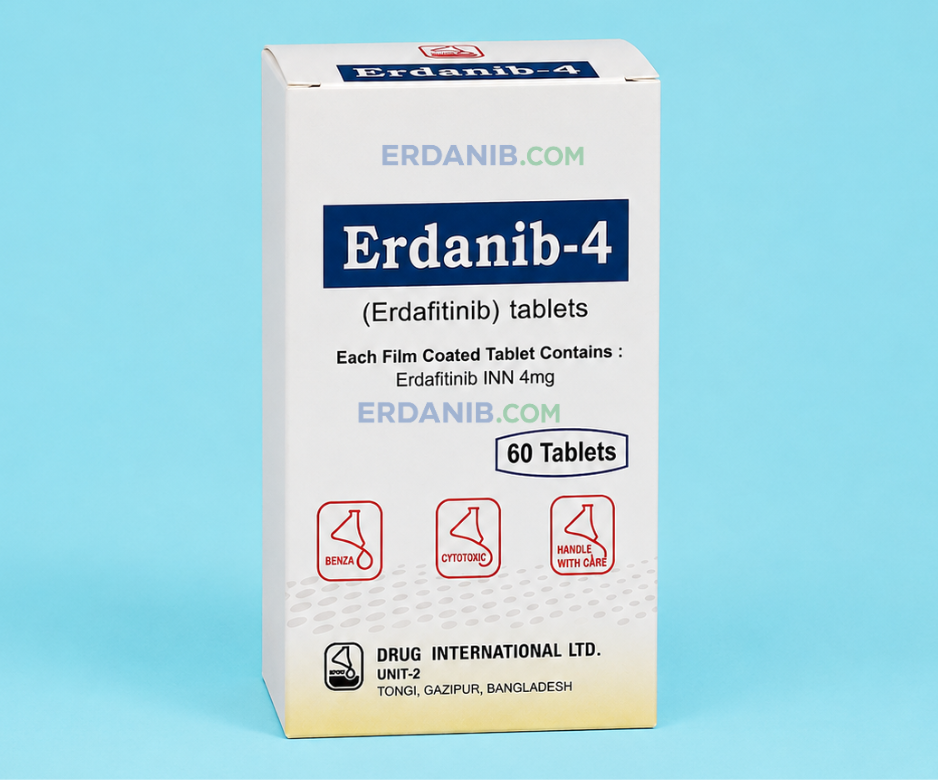
Erdanib 4 mg & 5 mg (Erdafitinib)
Erdanib is identified on this website as a product containing erdafitinib in the stated strengths of 4 mg and 5 mg. Product-specific information such as the manufacturer, marketing authorization holder, manufacturing site, dosage form, regulatory status, packaging, availability and commercial supply chain should be verified against the actual product packaging and applicable regulatory documentation before being presented as established fact.
Erdafitinib is an orally administered fibroblast growth factor receptor (FGFR) tyrosine kinase inhibitor used in selected oncology settings. In the United States, the established reference product is BALVERSA (erdafitinib), which is approved for specified adults with locally advanced or metastatic urothelial carcinoma whose tumors have susceptible FGFR3 genetic alterations, subject to the applicable treatment and diagnostic requirements.
Drug International Ltd. About the Manufacturer
Drug International Limited is a pharmaceutical manufacturer based in Bangladesh. The company was established in 1974 as a private limited company and later began pharmaceutical formulation and production. Its official company profile describes it as one of Bangladesh’s established pharmaceutical manufacturers, with a focus on quality, innovation, and international manufacturing standards.
Drug International has developed a broad pharmaceutical portfolio covering multiple therapeutic areas. Its products include medicines in areas such as oncology, cardiovascular care, antibiotics, respiratory medicine, gastroenterology, neurology, and diabetes. The company also manufactures products in different dosage forms, including tablets, capsules, injections, syrups, suspensions, creams, ointments, and soft gelatin capsules.
One of the company’s notable areas of specialization is soft gelatin capsule manufacturing. Drug International states that it was the first company in Bangladesh to formulate medicines in soft capsule form and has maintained a strong position in this field.
Manufacturing & Quality Standards
Drug International reports that its manufacturing facilities are designed and operated according to WHO Good Manufacturing Practices (WHO-cGMP) concepts and applicable local pharmaceutical regulations. Its facilities include production areas, quality-control laboratories, product-development laboratories, engineering facilities, water-treatment systems, and an effluent-treatment plant.
Head Office: Khwaja Enayetpuri (R) Tower17, Bir Uttam K.m. Shafiullah Road (Green Road),dhaka-1205, Bangladesh.
Factory – 1: 252, Tongi Industrial Area, Tongi, Gazipur, Bangladesh.
Factory – 2: 13A & 14A, Tongi I/A, Squibb Road, Tongi, Gazipur, Bangladesh.
Factory – 3: 31/1, Satrong Road, Gopalpur, Tongi Industrial Area, Gazipur, Bangladesh.
Factory (HERBAL & UNANI): Plot #100, 103-106, Block – A, Kathaldia, Tongi I/A, Tongi, Gazipur.
| Topic | Information |
|---|---|
| Product name | Erdanib |
| Active ingredient | Erdafitinib |
| Stated strengths | 4 mg and 5 mg |
| Dosage form | Film-coated oral tablet |
| Route of administration | Oral, subject to product documentation |
| Drug class | FGFR tyrosine kinase inhibitor |
| Therapeutic category | Antineoplastic medicine |
| Reference product | BALVERSA |
| Original discovery/development | Astex Pharmaceuticals and Janssen collaboration |
| Specific Erdanib manufacturer | Drug International Limited |
The established U.S. BALVERSA product is supplied as 3 mg, 4 mg and 5 mg film-coated tablets. The 4 mg and 5 mg strengths therefore correspond to recognized erdafitinib tablet strengths, but the existence of these strengths for the reference product does not, by itself, establish the formulation, manufacturer or authorization status of the Erdanib-branded product.
What Is Erdafitinib?
Erdafitinib is a targeted anticancer medicine that inhibits selected members of the FGFR family of receptor tyrosine kinases.
FGFR signaling participates in processes such as cellular growth, proliferation, differentiation and survival. Certain cancers contain genetic alterations affecting FGFR signaling, allowing these pathways to contribute to tumor development or progression.
By inhibiting susceptible FGFR signaling, erdafitinib can interfere with molecular pathways that may support the growth and survival of tumor cells.
Erdafitinib is therefore different from conventional cytotoxic chemotherapy. It is classified as a molecularly targeted therapy, and its use in appropriate patients depends on the characteristics of the cancer and the applicable regulatory indication.
How Does Erdafitinib Work?
Erdafitinib is a small-molecule inhibitor of selected FGFR1, FGFR2, FGFR3 and FGFR4 signaling.
FGFRs are receptor tyrosine kinases located on the cell surface. When activated by their ligands, they can transmit intracellular signals involved in cell proliferation, survival and other biological processes.
Some tumors contain activating or otherwise susceptible FGFR alterations. In these cancers, abnormal FGFR signaling may contribute to tumor growth.
Erdafitinib inhibits FGFR signaling and can consequently interfere with these tumor-promoting pathways.
Simple Explanation
In simple terms, erdafitinib is designed to block abnormal FGFR signaling that can help certain cancer cells grow and survive.
Because FGFR pathways also participate in normal physiological functions, inhibiting them can affect healthy tissues and produce treatment-related adverse reactions. This is one reason erdafitinib requires appropriate medical supervision and monitoring.
What Is Erdafitinib Used For?
Approved uses depend on the country, regulatory authority, tumor characteristics and current prescribing information.
In the United States, BALVERSA is approved for selected adults with locally advanced or metastatic urothelial carcinoma with susceptible FGFR3 genetic alterations whose disease has progressed on or after at least one prior systemic therapy.
The U.S. labeling also specifies treatment considerations concerning prior immune checkpoint inhibitor therapy. BALVERSA is not recommended for patients who are eligible for and have not received prior PD-1 or PD-L1 inhibitor therapy, according to the applicable U.S. prescribing information.
The relevant FGFR alteration must be established using an appropriate FDA-approved companion diagnostic or other testing method specified by the applicable regulatory framework.
Urothelial Carcinoma
Urothelial carcinoma is a cancer arising from the urothelial lining of the urinary tract. It most commonly involves the bladder but can also occur elsewhere in the urinary system.
A subset of urothelial cancers contains susceptible FGFR alterations. Erdafitinib provides a targeted treatment option for appropriately selected patients with these molecular characteristics.
Molecular Selection
Erdafitinib is not intended to be used solely because a patient has urothelial carcinoma.
The tumor’s molecular profile is important. Appropriate testing is therefore an important component of determining whether a patient may be eligible for treatment under the applicable indication.
Reference Product: BALVERSA
BALVERSA is the established reference brand associated with erdafitinib in the United States.
The reference product is supplied as erdafitinib tablets in 3 mg, 4 mg and 5 mg strengths.
A separate product containing erdafitinib should not automatically be described as identical to BALVERSA. Products containing the same active pharmaceutical ingredient may differ in:
- Manufacturer
- Marketing authorization holder
- Manufacturing location
- Excipients
- Tablet formulation
- Packaging
- Regulatory authorization
- Distribution arrangements
- Commercial supply chain
Accordingly, Erdanib should be described as a product containing erdafitinib unless documentation establishes a specific regulatory or commercial relationship with BALVERSA.
Originator and Development History
Erdafitinib was discovered through the Astex Pharmaceuticals and Janssen collaboration.
Astex has described its FGFR inhibitor program as originating from earlier collaborative research involving Cancer Research UK/Newcastle Cancer Centre. The erdafitinib development program subsequently proceeded through collaboration with Janssen under a worldwide collaboration and license arrangement established in 2008.
Janssen was responsible for the clinical development and commercialization of erdafitinib.
The reference product associated with the medicine is BALVERSA.
Originator Versus Manufacturer
The originator or developer of an active ingredient should not automatically be identified as the manufacturer of every product containing that ingredient.
For Erdanib, these roles should be kept separate:
- Originator/development history: Astex Pharmaceuticals and Janssen collaboration.
- Reference product: BALVERSA.
This distinction is important when presenting pharmaceutical product information accurately.
Erdanib 4 mg and 5 mg
The Erdanib product is identified on this website in 4 mg and 5 mg strengths.
The established BALVERSA reference product also contains 4 mg and 5 mg tablet strengths. However, the strength alone does not establish that Erdanib has the same formulation, manufacturer, packaging or regulatory status as BALVERSA.
4 mg Strength
A 4 mg strength represents a dosage unit containing 4 mg of erdafitinib, subject to confirmation of the specific Erdanib product documentation.
5 mg Strength
A 5 mg strength represents a dosage unit containing 5 mg of erdafitinib, subject to confirmation of the specific Erdanib product documentation.
The appropriate dose for an individual patient should be determined from the applicable prescribing information and the patient’s clinical circumstances.
Dosage and Administration
Erdafitinib dosing is indication-specific and patient-specific. The prescribed regimen may depend on the disease being treated, tumor molecular characteristics, treatment response, adverse reactions and other clinical factors.
For the reference product, treatment is administered orally according to the applicable prescribing information.
Dose modification, interruption or discontinuation may be necessary when clinically significant adverse reactions occur.
Important
The stated 4 mg and 5 mg Erdanib strengths should not be interpreted as recommended individual treatment doses.
Patients should not select, combine, increase, decrease or discontinue erdafitinib doses based solely on information published on this website.
The exact dosing instructions should come from the prescribing information applicable to the product and jurisdiction and from the treating healthcare professional.
Monitoring During Treatment
Erdafitinib treatment requires appropriate clinical monitoring because the medicine can affect several physiological systems.
Depending on the patient’s treatment plan, monitoring may include:
- Serum phosphate
- Kidney function
- Liver function
- Eye examinations
- Visual symptoms
- Electrolytes
- Oral and mucosal health
- Skin and nail changes
- Treatment-related adverse reactions
The precise monitoring schedule should follow the applicable prescribing information.
Safety at a Glance
Erdafitinib has medicine-specific safety considerations. Important adverse reactions and risks include:
- Ocular toxicity
- Retinal pigment epithelial detachment
- Hyperphosphatemia
- Stomatitis
- Nail disorders
- Palmar-plantar erythrodysesthesia
- Dry mouth
- Diarrhea
- Skin effects
- Dry skin
- Eye disorders
- Reproductive and embryo-fetal toxicity
The severity and frequency of adverse reactions may vary between patients and treatment settings.
Ocular Toxicity
Eye-related adverse reactions are an important consideration during erdafitinib treatment.
Erdafitinib can cause ocular effects, including retinal pigment epithelial detachment (RPED).
Patients should report new or worsening visual symptoms promptly. Ophthalmic monitoring may be required according to the applicable prescribing information.
Patients should not ignore changes in vision while receiving treatment.
Hyperphosphatemia
Erdafitinib can increase serum phosphate levels.
Because phosphate levels are pharmacologically relevant to erdafitinib treatment, serum phosphate monitoring is an important component of treatment management.
Healthcare professionals may modify treatment depending on phosphate levels and other clinical factors.
Stomatitis and Oral Effects
Inflammation or irritation of the mouth, including stomatitis, can occur during treatment.
Patients should report persistent or significant mouth discomfort, ulcers or difficulty eating and drinking to their healthcare team.
Skin and Nail Reactions
Erdafitinib can cause dermatologic and nail-related adverse reactions.
These may include:
- Dry skin
- Skin reactions
- Nail disorders
- Hand-foot syndrome/palmar-plantar erythrodysesthesia
Patients should discuss persistent or severe symptoms with their healthcare professional.
Diarrhea and Gastrointestinal Effects
Diarrhea may occur during erdafitinib treatment.
Persistent or severe diarrhea can contribute to dehydration and other complications. Significant symptoms should therefore be reported promptly.
Reproductive and Pregnancy Considerations
Erdafitinib may cause fetal harm based on its pharmacologic and nonclinical characteristics.
Pregnancy considerations should be discussed with an appropriate healthcare professional before treatment begins.
Patients who could become pregnant should receive appropriate counseling regarding contraception and pregnancy risks according to the applicable prescribing information.
Drug Interactions
Erdafitinib may interact with other medicines.
Patients should provide their healthcare professional with a complete list of:
- Prescription medicines
- Non-prescription medicines
- Vitamins
- Herbal products
- Supplements
The treating healthcare professional should review potential interactions before and during therapy.
Patients should not begin or discontinue another medicine without appropriate medical advice.
Who Should Not Take Erdafitinib?
Whether erdafitinib is appropriate depends on the patient’s cancer diagnosis, molecular findings, previous treatment, organ function, concomitant medicines and other clinical factors.
A patient should not assume that erdafitinib is appropriate merely because an FGFR alteration is present.
The applicable prescribing information should be reviewed for contraindications, warnings, precautions and eligibility requirements.
Drug International Ltd. Verification Process
Scan the QR code printed on the product box. The QR code will take you to the official drug product verification page, where you can complete the verification process.
The QR code will direct you to the Drug International Ltd. e-verification page, where you can complete the product verification process.
After completing the verification, check the result carefully to confirm whether the product is genuine.
If the verification indicates that the product is fake or unauthorized, do not use it. Report the suspected counterfeit product and take appropriate legal action against the supplier through the Directorate General of Drug Administration (DGDA), World.
Always purchase medicines from licensed pharmacies or authorized suppliers and verify the product before use.
Erdanib Manufacturer
The specific manufacturer of Erdanib is currently: Drug International Ltd.
No company should be identified as the manufacturer without product-specific documentary evidence.
Regulatory Status
The regulatory status of the specific Erdanib-branded product is: Drug International Ltd.
Approval of the active ingredient or reference product does not automatically establish approval of every product marketed under another brand name.
Erdanib Compared With BALVERSA
| Feature | Erdanib | BALVERSA |
|---|---|---|
| Active ingredient | Erdafitinib | Erdafitinib |
| Stated strengths on this website | 4 mg and 5 mg | 3 mg, 4 mg and 5 mg |
| Drug class | FGFR tyrosine kinase inhibitor | FGFR tyrosine kinase inhibitor |
| Reference status | Product-specific relationship requires verification | Established reference product |
| Manufacturer | Drug International Ltd. | Janssen-related reference product information |
The table should not be interpreted as establishing pharmaceutical equivalence, therapeutic interchangeability or regulatory equivalence between the two products.
Why Product-Specific Verification Matters
The same active ingredient can be present in products made by different manufacturers.
For pharmaceutical transparency, it is important to distinguish:
Active ingredient
The medicinal substance responsible for the pharmacological effect.
Reference product
The established product against which a regulatory pathway may be based, depending on the jurisdiction.
Generic or alternative branded product
A product containing the same active ingredient but potentially produced and authorized by a different company.
Manufacturer
The entity responsible for manufacturing the specific product.
Marketing authorization holder
The entity legally responsible for the medicinal-product authorization in a particular jurisdiction.
Distributor
An entity involved in commercial distribution.
These roles should not be presented as interchangeable.
Clinical Use and Professional Supervision
Erdafitinib is an oncology medicine intended for appropriately selected patients.
Treatment decisions may require consideration of:
- Tumor type
- Disease stage
- FGFR3 molecular alterations
- Previous systemic treatment
- Previous immunotherapy
- Organ function
- Concomitant medicines
- Potential adverse reactions
- Applicable regulatory requirements
The decision to prescribe erdafitinib belongs to an appropriately qualified healthcare professional.
Regulatory Differences Between Countries
Regulatory authorities may use different wording for indications, diagnostic requirements, treatment lines, dosing recommendations and safety precautions.
Information applicable to BALVERSA in the United States should not automatically be presented as the authorization wording for every other country.
Similarly, the authorization of an erdafitinib product in one jurisdiction does not establish authorization in another.
For Erdanib specifically, country-specific authorization should be verified using the relevant regulatory authority and product documentation.
Frequently Asked Questions
What is Erdanib?
Erdanib is identified on this website as a product containing erdafitinib in stated 4 mg and 5 mg strengths. Product-specific manufacturer and regulatory information requires verification.
What is erdafitinib?
Erdafitinib is an oral FGFR tyrosine kinase inhibitor used in selected oncology patients whose tumors have appropriate molecular characteristics under an applicable approved indication.
What is erdafitinib used for?
In the United States, the reference product BALVERSA is approved for selected adults with locally advanced or metastatic urothelial carcinoma with susceptible FGFR3 genetic alterations under specified treatment conditions.
What is BALVERSA?
BALVERSA is the established reference brand for erdafitinib in the United States.
Who developed erdafitinib?
Erdafitinib was discovered through an Astex Pharmaceuticals and Janssen collaboration, with the development program progressing under Janssen.
Who manufactures Erdanib?
The specific manufacturer of Erdanib is [Information requires verification]. It should not be assumed to be the same company associated with BALVERSA.
Are Erdanib and BALVERSA the same medicine?
They contain the same active ingredient according to the information supplied for this website, but they should not automatically be described as identical products. Manufacturer, formulation, excipients, authorization and packaging may differ.
What strengths of Erdanib are listed?
The Erdanib product is identified on this website in 4 mg and 5 mg strengths.
What strengths does BALVERSA have?
The U.S. reference product is supplied in 3 mg, 4 mg and 5 mg tablet strengths.
How does erdafitinib work?
Erdafitinib inhibits selected FGFR1–4 signaling pathways, interfering with molecular signals that can contribute to tumor-cell growth and survival in susceptible cancers.
Does erdafitinib require genetic testing?
Use in the relevant urothelial-carcinoma setting depends on identifying susceptible FGFR3 genetic alterations using an appropriate diagnostic approach specified by the applicable regulatory information.
What are important erdafitinib side effects?
Important risks include ocular toxicity, retinal pigment epithelial detachment, hyperphosphatemia, stomatitis, nail disorders, palmar-plantar erythrodysesthesia, dry mouth, diarrhea, skin effects and reproductive toxicity.
Does erdafitinib affect the eyes?
Yes. Ocular toxicity, including retinal pigment epithelial detachment, is an important safety consideration. Patients should promptly report visual changes.
Does erdafitinib increase phosphate levels?
Yes. Hyperphosphatemia is a recognized effect, and serum phosphate monitoring may form part of treatment management.
Can erdafitinib be taken during pregnancy?
Erdafitinib may cause fetal harm. Pregnancy and contraception considerations should be discussed with a healthcare professional.
Can I change my erdafitinib dose myself?
No. Dose selection and modification should be determined by the treating healthcare professional according to the applicable prescribing information and clinical circumstances.
Is Erdanib approved in my country?
The regulatory status of the specific Erdanib-branded product is [Information requires verification]. Authorization should be confirmed with the relevant national regulatory authority.
Medical Information Disclaimer
Erdanib.com is intended to provide general pharmaceutical and medical information for educational purposes.
This information is not a substitute for professional medical assessment, diagnosis, prescribing information or individualized treatment advice.
Erdafitinib is a prescription anticancer medicine. Patients should use it only under appropriate medical supervision and according to the official product information applicable to their country.
Do not start, stop, increase, decrease or otherwise change treatment based solely on information presented on this website.
Product-specific statements concerning the Erdanib manufacturer, marketing authorization holder, manufacturing site, regulatory status, packaging or commercial supply chain should be supported by appropriate documentation. Where documentation is unavailable, this page deliberately identifies the information as requiring verification.
Editorial and Regulatory Notice
The information about erdafitinib and BALVERSA provides background on the active ingredient and reference product. It should not be interpreted as proof that every product containing erdafitinib has the same authorization, formulation, manufacturing source or indications.
Regulatory approvals, prescribing information and safety requirements can change. Readers should consult the latest official regulatory and product documentation before making clinical or pharmaceutical decisions.
Source basis: The supplied website-content file establishes the same product-information approach used for the Lenvaxen site, including separation of generic/reference-product information from unverified product-specific manufacturer and regulatory claims.
Daniel R.
Erdanib was clearly explained, especially the information about erdafitinib, FGFR3 testing, and treatment monitoring. The FAQ section also made it easier to understand the important points.
Michael T.
I found the information about Erdanib 4 mg and 5 mg useful and easy to follow. The explanations about phosphate monitoring and possible eye-related effects were particularly helpful.
Sarah M.
The information is presented in a simple and organized way. I especially appreciated the details about how erdafitinib works, its potential side effects, and why genetic testing may be important.
Latest News
Hello world!
August 18, 2026 | by Erdanib
Welcome to WordPress. This is your first post. Edit or delete it, then start writing!
Read More →
FAQs
Erdafitinib is used in selected patients with locally advanced or metastatic urothelial carcinoma when the tumor has susceptible FGFR3 genetic alterations.
FGFR stands for fibroblast growth factor receptor. FGFR proteins are involved in cellular signaling pathways that regulate processes such as cell growth and survival.
FGFR3 testing helps identify patients whose tumors contain susceptible genetic alterations for which erdafitinib may be an appropriate targeted treatment.
Yes. The current U.S. BALVERSA regimen is administered orally once daily. The prescribed dose should be followed exactly as directed by the treating healthcare professional.
Taking erdafitinib according to a consistent daily schedule can help maintain regular treatment. Follow the specific instructions provided by your healthcare professional and product labeling.
Erdafitinib can cause ocular adverse effects, including retinal pigment epithelial detachment. Appropriate eye examinations and prompt reporting of visual changes are therefore important during treatment.
Erdafitinib can increase serum phosphate levels. Phosphate monitoring is part of treatment management and can help guide dose decisions.
Yes. Stomatitis and dry mouth are among the reported adverse reactions associated with erdafitinib. Persistent or significant mouth symptoms should be discussed with a healthcare professional.
Yes. Nail disorders, dry skin and palmar-plantar erythrodysesthesia are among the treatment-related effects reported with erdafitinib.
Tell your healthcare professional about your medical history, eye problems, pregnancy or plans for pregnancy, all prescription and non-prescription medicines, and any supplements you use. This information can help with appropriate treatment and monitoring.